
Travertine Care Las Vegas — Hole Filling, Finish Care & Pool Deck Maintenance
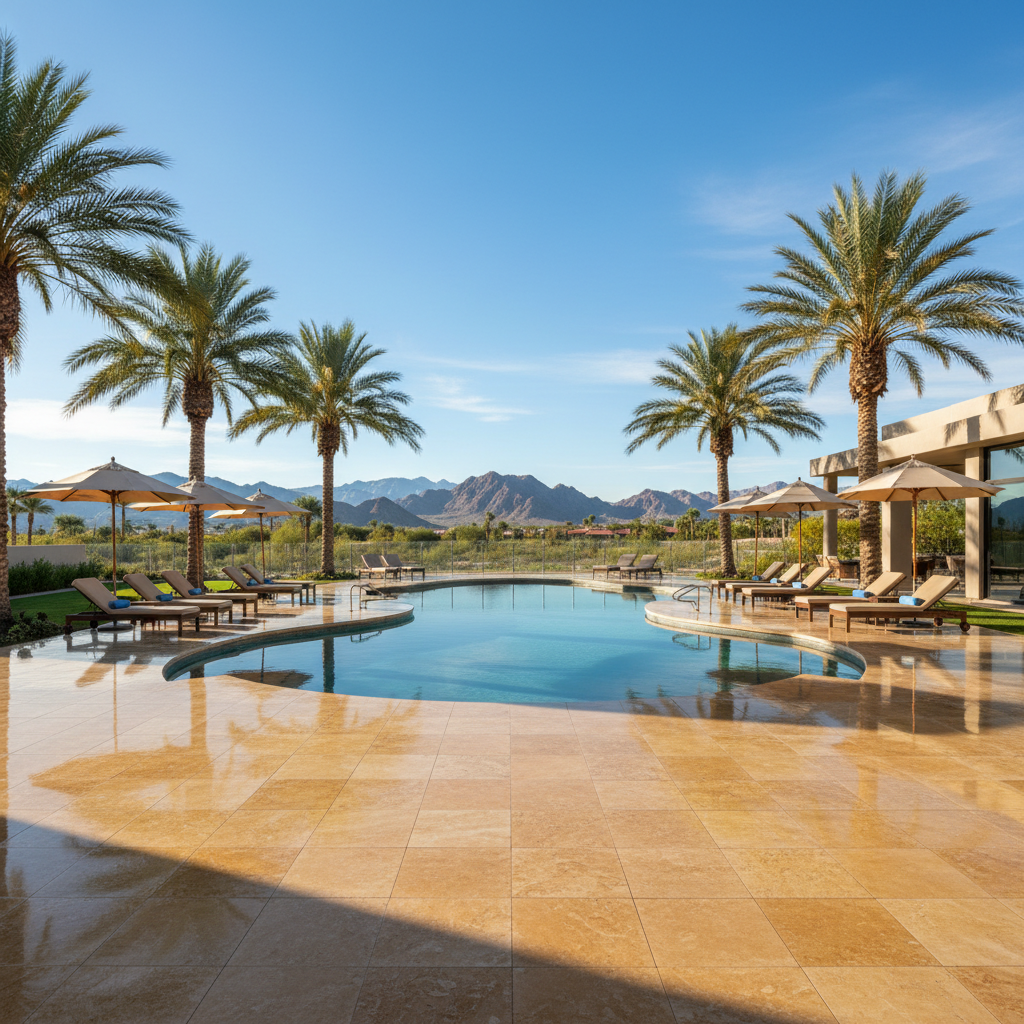
Travertine is the only stone in a Las Vegas home that comes with holes on purpose. It formed in mineral hot springs, where escaping carbon dioxide left gas channels through the calcium carbonate as it hardened — so every travertine tile is riddled with voids from top to bottom, not just on the face you walk on. That single fact drives almost every travertine care decision: how holes get filled and why they reopen, how each finish wants to be treated, and why the same stone needs completely different care on a Summerlin pool deck than in a Henderson master bath. As part of the Las Vegas Valley's most experienced stone restoration team, we have spent 20+ years caring for travertine on both sides of the patio door.
What Makes Travertine Care Different
- • Voids run through the full stone body — new holes surfacing is normal, not damage
- • Fill choice matters: epoxy indoors, cement grout fill outdoors
- • Four finishes (polished, honed, tumbled, brushed) — each with different care priorities
- • Las Vegas hard water at 278 parts per million (ppm) crystallizes inside open pores
- • Pool splash-out carries 200–400 ppm calcium onto deck stone every swim day
- • Hole refilling $3–$5/sqft • deep clean + seal $4–$10/sqft • free in-home estimates
- • Family-owned, 5-star rated: (702) 809-8436
Why travertine has holes — and why they keep coming back
When travertine is quarried and cut into tile, the saw exposes whichever voids happened to intersect that cutting plane. The factory fills those exposed voids with grout or epoxy, and the tile arrives looking solid. But the fill is only a cap. Millimeters below the surface sit thousands more voids the saw never touched — separated from your feet by thin bridges of stone.
Three forces open those bridges over time:
- Wear — every year of foot traffic removes a microscopic layer of surface. As the wear layer descends, it intersects new voids. A 20-year-old travertine floor in an Anthem entryway is showing voids that were sealed inside the stone the day it was installed.
- Point loads — high heels, unpadded chair legs, dropped pans, and vacuum beater bars concentrate force on a spot the size of a dime. If a near-surface void sits under that spot, the stone bridge collapses and a "new hole" appears overnight.
- Thermal cycling — this is the outdoor killer in Las Vegas. A pool deck surface can go from 60°F at dawn to over 150°F on a July afternoon. Stone and fill expand at different rates through that swing, and rigid fills gradually work loose and pop out.
None of this means the floor is failing. It means travertine behaves like travertine — and refilling is routine maintenance, the way regrouting is for tile. We refill opened voids at $3–$5 per square foot, sand the fill flush, and blend it so the repair disappears into the surrounding stone.
Epoxy fill vs grout fill: choosing the right material
The fill material is the most consequential choice in travertine hole repair, and the right answer flips depending on whether the stone lives indoors or out.
| Factor | Epoxy / Resin Fill | Cement Grout Fill |
|---|---|---|
| Best for | Indoor floors, showers, countertops | Pool decks, patios, outdoor steps |
| Appearance | Color-matched, hones and polishes flush with the stone | Matte, slightly textured — suits tumbled surfaces |
| Water behavior | Waterproof plug — ideal in wet indoor areas | Breathable — lets subsurface moisture escape instead of trapping it |
| Desert heat cycling | Rigid — tends to pop loose outdoors within a few summers | Tolerates 60°F-to-150°F surface swings far better |
| Lifespan and renewal | 15–20 years indoors before refilling is needed | Sacrificial by design — inexpensive to renew every few years |
| Cost | $3–$5/sqft | $3–$5/sqft |
A pattern we correct constantly: a handyman fills pool deck voids with indoor epoxy, and by the second summer the plugs sit proud of the surface or lie loose in the pool skimmer. Outdoor travertine in this climate wants a fill that moves and breathes with the stone — or, often, no fill at all in the field of the deck (more on that below).
The four travertine finishes — and how care changes with each
Travertine is sold in four standard finishes, and each one shifts what you are protecting the stone against. The mechanical work of changing or restoring a finish is its own subject — our travertine polishing guide covers the honing and polishing process, costs by condition, and DIY limits. This section is about living with each finish day to day.
| Finish | Where You'll Find It in Las Vegas | Care Priority |
|---|---|---|
| Polished (gloss) | Formal entries and older luxury homes; less common today | Guard the gloss — hard water haze and etch spots show first and worst here |
| Honed (matte/satin) | The default for valley interiors installed 2000–2015 | Keep grit off — desert dust micro-scratches read as gradual traffic-path dulling |
| Tumbled (textured, soft edges) | Pool decks, patios, outdoor kitchens across Henderson and Summerlin | Seal often — fully open pores absorb everything; rinse rather than scrub |
| Brushed (worn, low sheen) | Tuscan- and Mediterranean-style interiors, feature walls | Vacuum with suction only — beater bars chip the brushed surface and fill edges |
The care rule that runs through all four: the more open the finish, the more the sealer is doing the work. Polished travertine's tight surface sheds liquid for a while even unsealed; tumbled travertine without sealer absorbs a splash of pool water — and its dissolved calcium — in seconds. If you are unsure which finish you have, run a dry hand across it in raking light: gloss reflects, honed glows softly, tumbled feels dimpled, brushed feels like worn leather.
Indoor travertine care: fighting water you can't see
Indoor travertine in Las Vegas rarely fails from spills or accidents. It fails slowly, from ordinary tap water. At 278 ppm hardness, every mop pass, every shower, and every drip that dries on travertine leaves calcium and magnesium behind — and unlike a glass shower door, travertine doesn't just hold deposits on its surface. Open pores and fill edges give minerals a path inside, where they crystallize and expand with temperature changes, slowly roughening the surface from within. Our hard water stain removal guide covers safe DIY treatment for early-stage deposits.
The three indoor zones that matter most
- Showers — the hardest room in the house for travertine. Squeegee walls after use, run the exhaust fan, and reseal annually. A travertine shower floor that stays dark for hours after use is telling you the sealer failed and the stone is saturating. Planning a larger update? See our guide to natural stone bathroom remodeling in Las Vegas.
- Kitchens — the risk here is acid, not minerals: citrus, tomato, wine, and vinegar all dissolve travertine's calcium carbonate on contact, leaving dull etch spots no cleaner can remove. Wipe spills immediately and keep a pH-neutral stone cleaner as the only product that touches the floor.
- Entryways — Mojave dust is a fine abrasive, and it rides in on every shoe. A walk-off mat outside and inside each exterior door, plus dry dust-mopping between washes, does more for a honed travertine entry than any product you can buy.
Two habits to drop: steam mops (heat and forced moisture break down sealer and stress fill) and "mop-and-shine" products (acrylic films that yellow over travertine and trap dirt against the fill lines). When a floor has years of either, professional stripping and resealing — deep cleaning with sealer runs $4–$10/sqft — resets it. Our stone sealing schedule guide covers timing room by room.
Outdoor travertine: pool decks, patios, and coping in the desert
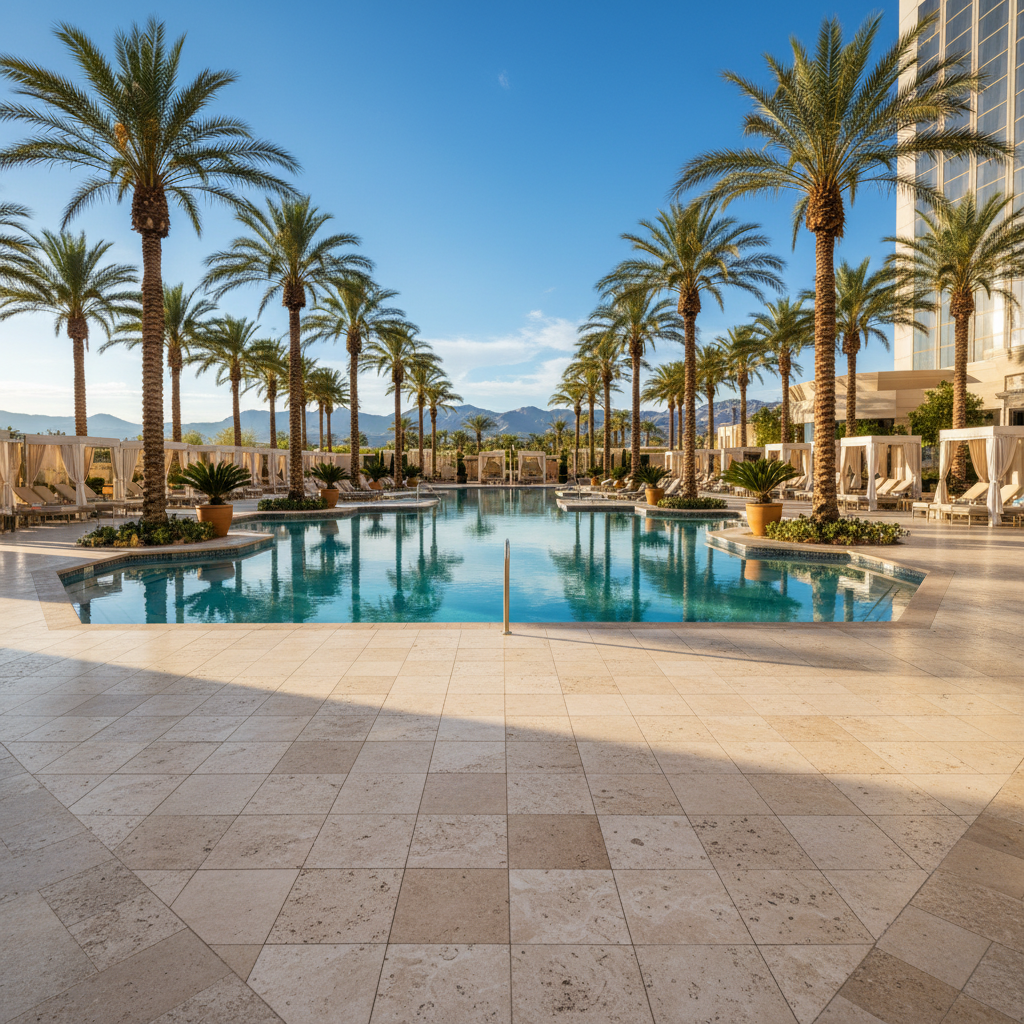
Travertine dominates Las Vegas pool decks for a physical reason: its light color and porous structure keep the surface noticeably cooler under bare feet than concrete or brick pavers on a 110°F afternoon. But the same outdoor exposure that makes it earn its keep also attacks it from four directions at once — none of which exist indoors.
- Pool splash-out — pool water here is balanced at roughly 200–400 ppm calcium hardness. In summer heat, splash-out evaporates in minutes, depositing that calcium on and into deck stone. The white "bathtub ring" creeping outward from the waterline onto coping is exactly this. Salt-chlorine systems add a second problem: salt crystals growing inside coping pores can flake the surface off in thin layers (spalling).
- UV — desert sun lightens warm travertine tones over several years and destroys sealer two to three times faster than indoor conditions. The fade is invisible until you move a planter and find the original color preserved underneath it.
- Monsoon dust — July through September storms drop fine alkaline dust across the valley. On tumbled travertine it settles into the texture, and sprinkler overspray then cements it into a gray crust that scrubbing only grinds deeper.
- Ground moisture and caliche — valley soil contains caliche, a natural calcium-carbonate-cemented layer. Moisture wicking up under an outdoor slab carries dissolved minerals through the stone and deposits them on top as white efflorescence, usually along edges and low spots.
The outdoor care rules we give every pool deck client
- Hose-rinse weekly during swim season — plain water, no chemicals. The goal is moving splash-out minerals and dust off the deck before evaporation locks them in.
- Seal annually with a breathable penetrating sealer — and never a topical gloss coating outdoors. Film-forming coatings trap ground moisture inside the stone, then blister and peel under UV.
- Leave the field texture open; fill selectively — open voids are slip resistance for wet feet. We fill only voids that have grown into trip hazards, typically at coping edges and step treads, using breathable grout fill.
- Rinse coping after water-chemistry days — the hour after adding salt, chlorine, or calcium chloride is when spilled granules and concentrated water do the most coping damage.
- Inspect fill each spring — winter nights below freezing plus daytime warmth cycle the stone dozens of times; loose fill shows up at the start of swim season and is cheapest to fix then.
A Las Vegas travertine care calendar
Because the desert drives travertine's stress cycle, its care runs on seasons rather than a generic weekly checklist:
| Season | What's Happening to the Stone | What to Do |
|---|---|---|
| Spring (Mar–May) | Winter thermal cycling has loosened outdoor fill; swim season is coming | Inspect and refill deck voids, reseal outdoor travertine before pool use ramps up |
| Summer (Jun–Sep) | Peak splash-out evaporation, 150°F surface temps, monsoon dust loading | Weekly deck rinse, squeegee showers daily (more indoor humidity from swamp-cooler homes), wipe coping after chemistry days |
| Fall (Oct–Nov) | Monsoon dust crust has built up in tumbled texture all summer | Deep-clean outdoor travertine while temperatures allow proper sealer cure |
| Winter (Dec–Feb) | Indoor season — more traffic, more mopping, holiday spills; freeze nights outside | Water-drop test indoor floors, schedule indoor deep cleaning or honing; our slowest season means fastest scheduling |
When travertine care needs a professional
Good home care keeps travertine stable — but some problems live below the surface, where cleaning products cannot reach. These are the triggers that mean it's time for a professional visit rather than another product purchase:
| What You're Seeing | What It Means | Professional Fix |
|---|---|---|
| More than a handful of open voids per room | Wear layer has reached a void-dense band of the stone | Batch refilling, $3–$5/sqft |
| Rough, gritty texture where it was smooth | Crystallized minerals in pores plus eroding fill edges | Mineral extraction and light honing, $5–$10/sqft |
| White haze that returns after every cleaning | Subsurface hard water deposits, not surface dirt | Deep extraction clean and seal, $4–$10/sqft |
| Chipped edges, cracks near coping or steps | Impact or thermal stress reaching structural level | Chip repair $100–$300; crack injection $150–$400; tile replacement $200–$600 |
| Widespread dullness, deep wear paths, old coatings | Surface needs mechanical renewal, not cleaning | Full restoration, $10–$18/sqft |
| Water darkens the stone within minutes | Sealer has failed | Standalone resealing, $0.50–$2/sqft, 30-day guarantee |
Restoration is nearly always the economical path — even badly neglected travertine rarely justifies tear-out once you compare numbers, as our restoration vs replacement cost analysis shows in detail. And if you're comparing contractors, our checklist on choosing a stone restoration company in Las Vegas covers the questions to ask — including whether a bidder understands the epoxy-versus-grout fill distinction above, which is a reliable travertine competence test.
Where we care for travertine across the valley
Travertine's footprint varies by neighborhood — and so does the work we do there:
- Las Vegas — from Strip-corridor condos with polished travertine baths to ranch homes with 1990s tumbled patios
- Henderson — the valley's densest concentration of travertine pool decks: Green Valley, Anthem, Seven Hills, MacDonald Highlands, Lake Las Vegas
- Summerlin — honed interior travertine throughout The Ridges, The Paseos, and Tournament Hills, much of it now 15–25 years into its wear layer
- Centennial Hills — Providence and Skye Canyon homes where builder-grade filled travertine is reaching first-refill age
- North Las Vegas — Aliante and Eldorado, including outdoor kitchens and covered patios
- Spring Valley and Paradise — older installations where decades of coating buildup and fill loss meet
- Lone Mountain, Red Rock, Sun City, and Boulder City — full service valley-wide, including HOA-scheduled community work
Frequently Asked Questions
Q: Why do new holes keep opening up in my travertine floor?
A: Travertine's voids run all the way through the stone body — factory filling only caps the voids that intersected the surface when the tile was cut. As the wear layer slowly abrades, new voids just below the surface get exposed, and point loads (heels, chair legs, vacuum beater bars) punch through the thin stone bridges over near-surface voids. It's normal travertine behavior, not a defect. Professional refilling costs $3–$5 per square foot, sanded flush and blended. Call (702) 809-8436.
Q: Should travertine holes be filled with epoxy or grout?
A: Location decides. Indoors, color-matched epoxy is right — it bonds hard, hones flush, and resists water. Outdoors in Las Vegas, cement-based grout fill performs better: it breathes, tolerates the deck's extreme surface temperature swings without popping out, and is cheap to renew as a sacrificial layer. Epoxy plugs outdoors often fail within a few summers because epoxy and stone expand at different rates in 150°F surface heat.
Q: Do I need to fill the holes in my travertine pool deck?
A: Usually not all of them. Open texture is part of why tumbled travertine works around pools — the voids add slip resistance for wet feet. We fill only voids that have become trip or toe-stub hazards, typically near coping edges and step treads, and leave the general texture open. What every outdoor deck does need is annual penetrating sealer, because open voids are direct channels for pool splash minerals.
Q: How is caring for tumbled travertine different from honed or polished?
A: Tumbled travertine has no gloss to protect but is the most absorbent finish — its pores and voids are fully open, so it needs sealer more often, and its texture traps desert dust that a flat mop glides over. Vacuum with suction only (beater bars chip fill and void edges) and rinse outdoor tumbled surfaces rather than scrubbing dust into the recesses. Honed and polished travertine flip the emphasis: protecting a smooth surface from mineral haze and etch spots.
Q: Does pool water damage travertine coping and decking?
A: Over time, yes — through evaporation rather than contact. Las Vegas pool water is balanced at roughly 200–400 ppm calcium hardness, and summer splash-out evaporates in minutes, leaving calcium on and inside the stone. Salt-chlorine pools are harder on travertine: salt crystals growing in the pores can spall coping surfaces. A weekly plain-water rinse in swim season and an annual breathable penetrating sealer are the two best defenses.
Q: Will the Las Vegas sun fade my outdoor travertine?
A: Direct UV gradually lightens warm gold and walnut tones over several years and degrades sealers two to three times faster than indoor conditions. The fade is even — usually unnoticed until a planter or rug moves and reveals the original color. Rotating furniture and using a color-enhancing penetrating sealer at the annual reseal keeps the tone deep and uniform. We don't recommend topical gloss coatings outdoors; they trap moisture and fail under UV.
Q: Why does my travertine shower floor feel gritty or rough?
A: Two things at once: minerals from 278 ppm hard water crystallizing in surface pores, and factory fill edges slowly eroding into raised rims around each void. Daily squeegeeing and pH-neutral cleaner slow it; once roughness is widespread, the fix is professional mineral extraction and light honing to re-level the surface — not more scrubbing, which wears fill faster than stone. See our hard water stain guide for early-stage DIY treatment.
Q: When does travertine care need a professional instead of DIY?
A: Call when fill is missing from more than a handful of spots per room, the surface feels rough where it used to be smooth, white haze survives stone-safe cleaning, a shower floor stays dark for hours after use, outdoor fill pops loose each summer, or cracks appear near coping and steps. Those are subsurface problems no cleaning product reaches. Free in-home assessments valley-wide: (702) 809-8436.
Talk to the People Who Do the Work
Night and Day Stone Restoration is family-owned, 5-star rated, and has cared for Las Vegas travertine — indoors and around pools — for more than 20 years. Every sealer application carries our 30-day guarantee, and every estimate is free, written, and given in your home by the people who will actually do the work.
Call (702) 809-8436 for a free travertine assessment.
Se habla español: (702) 764-1528
Also serving: marble polishing, granite repair, limestone cleaning, slate sealing, terrazzo restoration.