
Limestone Care & Restoration Las Vegas — Soft Stone, Hard Water, and How We Keep Yours Alive
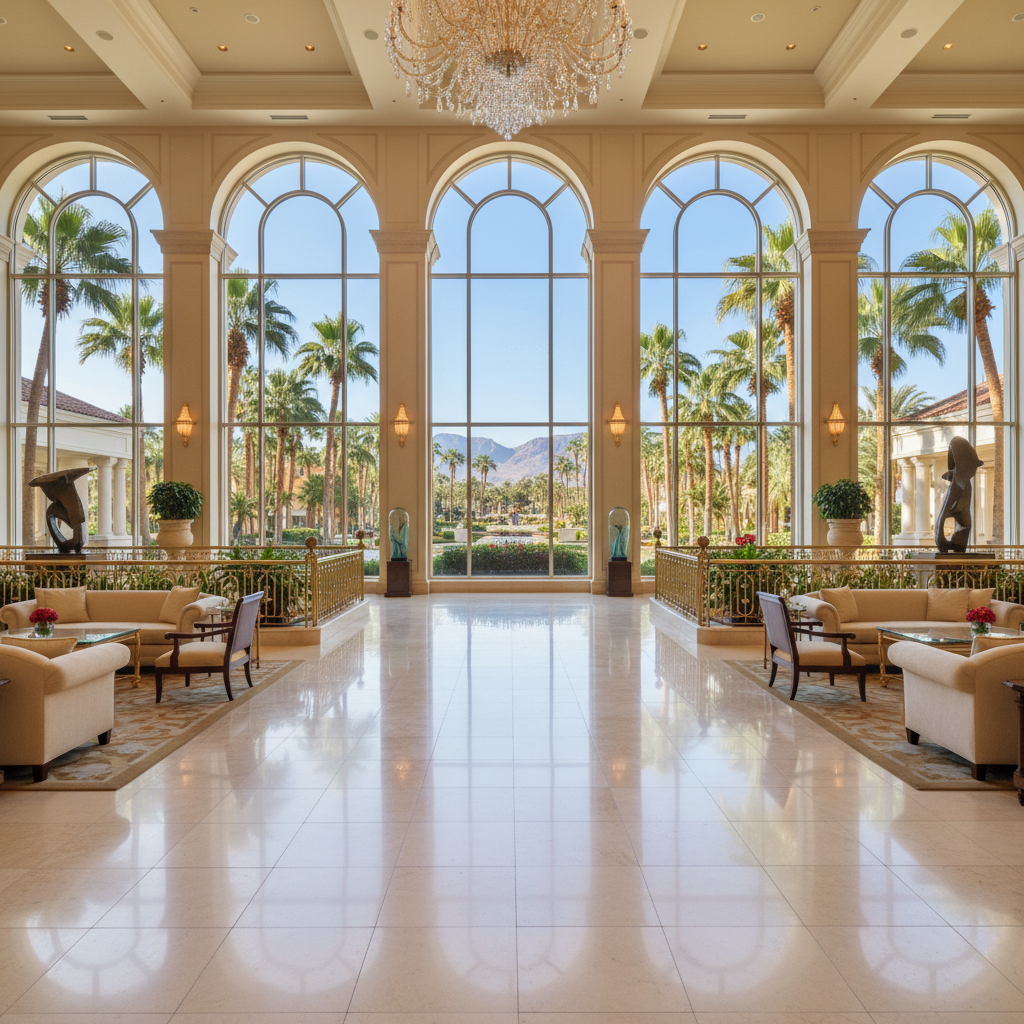
Here is the problem no other stone in your home has: Las Vegas tap water is, quite literally, dissolved limestone. Our water comes from Lake Mead — Colorado River water that spent its whole journey south cutting through limestone canyons and picking up their minerals. By the time it hits your faucet, it carries roughly 278 ppm of dissolved calcium carbonate. Your limestone floor is made of calcium carbonate.
So every drop that dries on your floor puts limestone back down on top of your limestone. On granite, that scale sits on the surface as a film. On limestone, calcite bonds to calcite — the deposit fuses with the stone underneath it. That single chemical fact is why limestone owners in the valley fight crust at grout lines, cloudy shower surrounds, and white ridges around pet bowls harder than owners of any other stone. And it is why the "obvious" fix — an acid descaler — is the one thing you must never do, because the acid cannot tell the crust from the floor.
Night and Day Stone Restoration has spent 20+ years untangling exactly this problem in Las Vegas homes. This page covers what makes limestone uniquely vulnerable here, what you can safely handle yourself, what to stop touching, and how our limestone-specific restoration process works. Call (702) 809-8436 for a free in-home limestone assessment.
The Vegas Limestone Problem in 30 Seconds
- • Tap water here carries ~278 ppm dissolved calcium carbonate — the same mineral your floor is made of
- • Scale bonds to limestone chemically; acid descalers dissolve the floor along with the crust
- • Calcite is Mohs 3; the quartz in desert dust is Mohs 7 — untracked dust sands your floor daily
- • We strip bonded minerals, hone out etching, repair, and seal — $5–$18/sqft, most jobs 1–2 days
- • Want the DIY polishing walkthrough instead? See our limestone floor polishing and care guide
- • Free estimates: (702) 809-8436 — family-owned, 30-day sealer guarantee
Why limestone is the most vulnerable stone we service
Limestone never went through the heat and pressure that turned its cousin into marble. It stayed sedimentary — layered, open, and soft. Four physical facts follow from that, and every one of them collides with the Las Vegas environment:
- It loses the hardness contest to dust. Calcite measures 3 on the Mohs scale. The quartz particles in Mojave dust measure 7. Every windy afternoon deposits a fine abrasive four steps harder than your floor, and every footstep grinds it in. This is why Las Vegas limestone develops dull traffic lanes years before the same floor would in a humid city.
- It drinks, it doesn't repel. Sedimentary limestone can hold several times the absorbed moisture of compressed marble. Hard water doesn't just dry on the surface — it soaks in, evaporates from inside the pores, and crystallizes minerals below the surface where no cleaner can reach them.
- It reacts to acid on contact. Geologists identify limestone by dripping acid on it and watching it fizz. That fizz is your floor dissolving. A lime wedge dropped at a barbecue, a splash of tomato sauce, a "natural" vinegar cleaner — each one leaves a permanent dull mark in the seconds before you can wipe it.
- Its worst enemy is chemically identical to it. Because scale and stone are the same mineral, deposits bond rather than rest — and every product engineered to dissolve scale will dissolve the stone with equal enthusiasm. Limestone is the one surface where the descaler aisle is a minefield.
None of this means limestone was the wrong choice. It means limestone in this valley needs a different playbook than the one printed on cleaner bottles — and a restoration partner who works with its chemistry instead of against it.
Damage triage: what you can fix yourself — and what to stop touching
Match what you're seeing on your limestone to the row below. Some of this is genuinely DIY-safe. Some of it gets more expensive every time someone scrubs at it.
| What you're seeing | What's actually happening | DIY or pro? |
|---|---|---|
| Water darkens the stone where it lands | Your sealer has expired — the stone is absorbing again | DIY test, pro fix. Confirm with a water drop; schedule resealing promptly |
| Light cloudy film near shower or sink | Early-stage mineral deposit, not yet bonded deep | DIY. pH-neutral stone cleaner, soft nylon brush, dry completely. Never a descaler |
| White crust or ridges at grout lines, faucets, pet bowls | Bonded scale — calcite fused to calcite | Pro. Requires mechanical extraction; scraping or acid makes it permanent damage |
| Dull spot shaped like a glass ring or splash | Acid etch — the surface itself dissolved | Mostly pro. Faint marks may respond to polishing powder; anything you can feel needs honing |
| Dark blotch that spread over days | Oil or organic stain absorbed into the pores | DIY first. Baking soda poultice, 24–48 hrs. If two rounds fail, we extract it ($100–$300/area) |
| Dull, grey lanes in walking paths | Abrasion — quartz dust has sanded the finish off | Pro. Diamond honing re-cuts the finish; no cleaner can bring back ground-off surface |
| White powdery bloom on patio or pool deck stone | Efflorescence — soil salts wicking up from below | Pro. Needs dry removal + moisture-source assessment. Do not hose it off — water feeds it |
| Crumbling edges, pits, or flaking layers | Spalling — moisture and salt breaking the stone apart along its bedding layers | Pro, soon. Progressive and accelerating; repair is $150–$350 per area if caught early |
Not sure which row you're in? Text a photo or call (702) 809-8436 — we'll tell you honestly if it's a $12 bottle of stone cleaner or a service visit. Etch marks and mineral deposits get confused constantly; our hard water stain removal guide shows how to tell them apart before you treat anything.
The desert limestone calendar: a maintenance rhythm built for Las Vegas
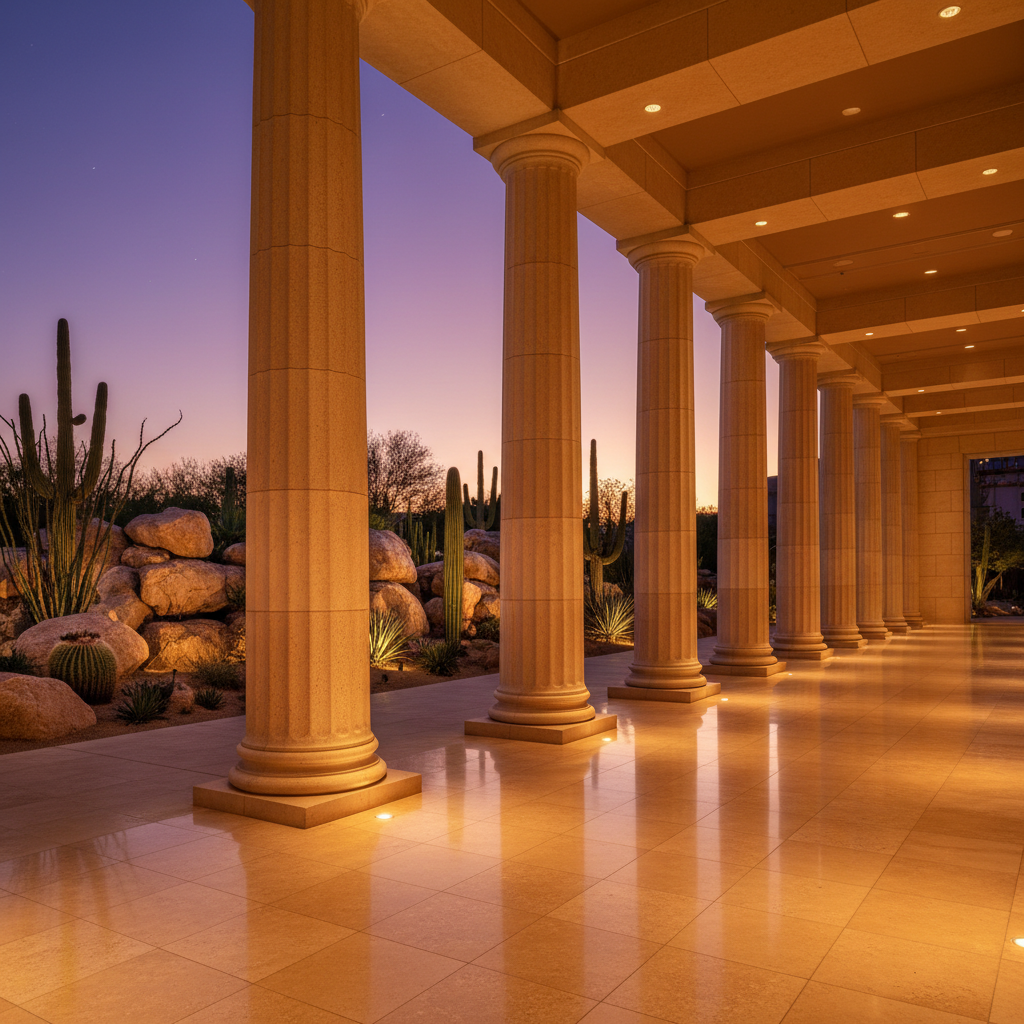
Generic limestone advice assumes a climate where dust settles and rain is clean. Ours does neither. Here is the regimen we give our own limestone clients, keyed to the valley's actual seasons:
Every day — the two-minute dust pass
Dry microfiber mop through entries, hallways, and kitchen paths. Remember the hardness gap: quartz dust at Mohs 7 versus your floor at Mohs 3. This single habit is the cheapest restoration deferral available — it removes the sandpaper before feet grind it in.
Every week — mop, then dry. Always dry.
Damp mop with a pH-neutral stone cleaner, then towel or dry-mop the floor. In our climate the drying step is not optional: mop water evaporates in minutes here, and when it does, the water leaves and the minerals stay — a faint deposit layer laid down with every "cleaning." Drying the floor yourself is how you break that cycle.
Spring (windy season) — defend the entries
March-through-May wind advisories load homes with fine dust. Double up on walk-off mats at every exterior door, shake them out often, and increase dust-mopping frequency on days the valley is blowing.
Summer — test your sealer, protect the patio
Drop a spoonful of water on interior limestone: if it darkens the stone within 10 minutes instead of beading, the sealer is done. Outdoors, surface temperatures over 110°F plus direct UV are actively breaking down sealer chemistry — summer is when outdoor limestone protection quietly fails. Our sealing schedule guide covers frequency by room and exposure.
Monsoon (July–September) — rinse after the mud rain
Monsoon storms drop rain through a dust column, and what lands on patios and pool decks is closer to liquid grit than water. After each storm, rinse outdoor limestone with plain water and squeegee or broom it dry. Check door thresholds where storm water may have wicked under and into interior stone.
Holidays — etch season
Most of the etch damage we hone out in January happened in November and December: wine, citrus, cocktails, and tomato sauce meeting unprotected limestone at parties. Trays and coasters on limestone surfaces, and blot — never wipe — anything that spills. For the full product-level care routine, spill protocol, and the complete DIY-versus-professional polishing walkthrough, see our limestone floor polishing and care guide.
How professional limestone restoration differs from marble work
A crew that treats limestone like slightly-cheaper marble will disappoint you or damage the floor. The stones are chemical cousins, but restoration decisions diverge at almost every step:
- The finish ceiling is different — and we say so upfront. Marble's compressed crystal structure takes a mirror polish. Most limestone tops out at a refined satin or soft sheen, because its looser sedimentary grain scatters light instead of reflecting it. We test-polish a small area during your estimate so you see your stone's realistic ceiling before committing. (If a contractor promises you mirror-gloss limestone sight unseen, keep looking — our guide to choosing a stone restoration company lists the other red flags.)
- Mineral removal is mechanical, not chemical. On acid-tolerant stones, bonded scale can be dissolved off. On limestone we extract it — controlled abrasion and stone-safe chemistry that stops at the deposit-stone boundary instead of eating through it.
- Grit progressions run gentler and stop sooner. Soft calcite removes fast under diamonds. We match the progression to your specific stone's density — a dense Jura limestone and an open, fossil-heavy Jerusalem stone off the same truck need different sequences — rather than running a standard marble schedule.
- Fossil voids and bedding pits get filled, not ignored. Honing limestone often opens small natural voids where shell fragments once sat. We fill these with color-matched material and hone them flush, the same way we handle chips and cracks ($150–$350 per repair).
- Sealing is non-negotiable and guaranteed. Every limestone restoration ends with a penetrating sealer worked into the stone's open pore structure, backed by our 30-day guarantee: if water stops beading within 30 days, we reseal free.
Most limestone cleaning-and-sealing visits finish in a single day; full restorations with grinding run one to two. Curious how this compares for other stones in your home? See our marble restoration page and travertine care page — travertine is limestone's hole-riddled sibling and gets its own approach.
What limestone work costs in Las Vegas
Real numbers, because you should have them before anyone visits your home:
| Typical Las Vegas scenario | What it usually takes | Typical range |
|---|---|---|
| Shower surround with bonded scale and soap film | Mechanical mineral extraction + reseal ($5–$12/sqft) | $500–$1,000, half a day |
| 300 sqft foyer/hallway with dull traffic lanes, expired sealer | Deep clean + hone worn areas + seal ($5–$10/sqft) | $1,500–$3,000, one day |
| Etched, stained kitchen floor needing full refinish | Grind + hone + optional polish + seal ($10–$18/sqft) | $3,000–$5,000+, 1–2 days |
| Single wine or citrus etch mark on a countertop | Spot honing and finish blending | From $150, same visit |
| Deep oil or organic stain that poulticing at home couldn't lift | Commercial-grade poultice extraction | $100–$300 per area |
| Patio or pool deck: efflorescence, chips, cooked sealer | Dry salt removal + repairs ($150–$350 ea.) + outdoor-rated seal | Quoted on-site — free estimate |
| Recently cleaned floor that just needs protection | Standalone penetrating sealer, 30-day guarantee | $0.50–$2/sqft |
For perspective: new limestone installation starts around $15–$50+ per square foot before demolition and disposal — so a 300 sqft replacement begins near $4,500 and climbs fast, while restoring the same floor rarely passes $3,600 and is done in a day or two. Even limestone that looks beyond saving — heavy etching, bonded scale, worn-through finish — almost always restores. The full math is in our restoration vs. replacement cost guide.
Where limestone lives in Las Vegas homes — and how each spot fails
After two decades in valley homes, we can usually predict the damage before we see it, because location determines failure mode:
- Entry foyers and great rooms — common in custom homes across Summerlin, The Ridges, Anthem, and Southern Highlands. Failure mode: dust abrasion. Dull traffic lanes from the front door, crisp finish along the walls.
- Shower surrounds and tub decks — often Jerusalem or other cream limestones. Failure mode: bonded scale. Daily hot water at 278 ppm plus evaporation is the fastest mineral-deposit engine in the house.
- Kitchen floors and islands — failure mode: etching and oil staining. Citrus, wine, vinegar, and cooking oil versus soft calcite and open pores.
- Patios and pool decks — failure mode: everything at once. UV-destroyed sealer, monsoon grit, and efflorescence driven by irrigation water pulling salts up through the valley's caliche soil.
- Fireplace surrounds — failure mode: soot absorption into unsealed pores and heat stress on old repairs.
We service limestone in every one of these settings across Las Vegas, Henderson, Summerlin, North Las Vegas, and all Clark County communities — see everything we do across the valley on our Las Vegas stone restoration page. Free in-home estimates, most appointments within the week.
Frequently Asked Questions
Q: Why does Las Vegas water damage limestone faster than other stones?
A: Las Vegas tap water comes from Lake Mead — Colorado River water that spent its journey dissolving limestone canyons upstream. By the time it reaches your faucet it carries roughly 278 ppm of dissolved calcium carbonate, which is the exact mineral your limestone floor is made of. When that water evaporates on limestone, the calcite it leaves behind bonds to the calcite in the stone instead of sitting loosely on top. On granite or slate, scale is a film you can strip. On limestone, it fuses. That is why limestone in Las Vegas develops crusted deposits faster and holds them tighter than any other stone we service.
Q: Can I use CLR, Lime-Away, or vinegar to remove hard water crust from limestone?
A: No — and this is the single most expensive mistake Las Vegas limestone owners make. Acid descalers work by dissolving calcium carbonate. Your limestone IS calcium carbonate, so the acid cannot tell the crust from the floor. It dissolves both, leaving a dull, rough, permanently etched patch where the deposit used to be. Professional mineral removal on limestone uses mechanical extraction and stone-safe chemistry that lifts bonded scale without attacking the calcite beneath it. Call (702) 809-8436 before reaching for a descaler.
Q: What is the white powder blooming on my outdoor limestone?
A: That is efflorescence — mineral salts migrating up through the stone and crystallizing on the surface as moisture evaporates. The Las Vegas Valley sits on caliche and naturally salty desert soil, and irrigation water wicks those salts up through slabs and into porous limestone from below. Hosing it off makes it worse, because you are adding the moisture that drives the cycle. Efflorescence needs dry mechanical removal and, in recurring cases, an assessment of where the moisture is entering. We handle both.
Q: Will a water softener protect my limestone?
A: It helps, but it is not a cure. A softener exchanges calcium for sodium, which dramatically slows new scale formation at showers, sinks, and mop water. It does nothing for deposits already bonded to the stone, nothing for etching from acidic spills, and nothing for abrasion from desert dust. Softened homes still need sealed limestone and periodic professional care — they just need the mineral-stripping side of it less often.
Q: How do I tell an etch mark from a hard water deposit on limestone?
A: Run a fingertip across it in raking light. A hard water deposit is raised — a film or ridge sitting on top of the surface, usually white or chalky. An etch mark is a dip — a dull spot where acid dissolved the polished surface, often in the shape of a glass ring or a splash. The fixes are opposites: deposits are removed by taking material off the surface, etching is repaired by honing the surrounding surface down to match. Misdiagnosing one as the other is how DIY attempts go wrong — our hard water stain guide walks through the diagnosis.
Q: What should I budget for limestone restoration in Las Vegas?
A: Deep cleaning runs $5–$8 per square foot, cleaning plus sealing $5–$12, honing $5–$10, polishing $6–$12, and heavy restoration with grinding $10–$18 per square foot. Poultice stain extraction is $100–$300 per area and chip repair $150–$350. Most residential limestone projects land between $1,500 and $5,000, completed in one to two days. Estimates are free, in-home, and in writing. Call (702) 809-8436.
Q: Can you make my limestone floor glossy like marble?
A: Usually not to a full mirror finish, and we would rather tell you that upfront. Marble's crystalline structure was compressed under heat and pressure, so it can be polished to high gloss — see our marble restoration page for that stone. Most limestone kept its looser sedimentary structure and tops out at a refined satin or soft sheen. Dense varieties like some Jura limestone take more polish than open, fossil-heavy stones. During your estimate we test a small area and show you the realistic ceiling for your specific stone before you commit to anything.
Q: Do you handle outdoor limestone patios and pool decks?
A: Yes. Outdoor limestone in Las Vegas fights three battles at once: UV and 110-degree surface heat breaking down sealers, monsoon dust-rain depositing grime and minerals every July through September, and salts wicking up from the valley's caliche soil. We clean, repair, and reseal outdoor limestone annually for most clients — sealers simply do not survive longer than that in our sun. Our sealing schedule guide has the full indoor/outdoor breakdown.
Q: Who actually shows up to do the work?
A: The same people you talk to on the phone. Night and Day Stone Restoration is family-owned and has restored natural stone across the Las Vegas Valley for over 20 years — no call center, no rotating crews. We schedule most limestone projects within the same week, serve every Clark County community from Summerlin to Henderson, and back every sealer application with a 30-day guarantee. Se habla español: (702) 764-1528.
Get a limestone specialist, not a generalist
Limestone is the stone where the wrong product, the wrong pad, or the wrong assumption does permanent damage. After 20+ years working with soft calcite in the hardest water in the country, we know exactly where those lines are — and we put every sealer application behind a 30-day guarantee.
Call (702) 809-8436 for a free in-home limestone assessment. Same-week scheduling across the Las Vegas Valley.
Se habla español: (702) 764-1528